

Guides ·
Job Shadowing in Manufacturing: How to Make It Work
What job shadowing is, why it takes so long on the factory floor, and a 6-step way to make it shorter and more consistent. Includes a job shadowing checklist you can copy.

Key takeaways
Job shadowing means a new employee follows an experienced worker and learns the job by watching. In manufacturing it is the most common way to train operators. It is also slow: what the new hire learns depends on who they shadow, the expert loses output while they teach, and nothing is left behind when the shift ends. You make shadowing shorter by giving the new hire the written steps first, then using shadowing to practice and check.
- Shadowing works best for judgment, feel, and edge cases. It works worst for the basic sequence of steps, which could be learned from a document or video.
- Two trainers rarely teach a task the same way. The new hire learns a mix of both.
- Senior operators are usually the busiest people on the floor. Every hour they spend explaining the basics is an hour of lost output.
- A shadowing plan with written steps, reverse shadowing, and a sign-off turns weeks of watching into days of guided practice.
What is job shadowing?
Job shadowing is a training method where a new or junior employee follows an experienced colleague through their normal work. The new person watches, asks questions, and slowly takes over parts of the job.
In offices, job shadowing is often a short visit to see what another role does. In manufacturing, it is usually the main way a new operator learns a machine, a line, or a station. The new hire stands next to an experienced operator for days or weeks until they can run the job alone.
It is one part of on-the-job training: the watching part. Full on-the-job training also includes practice under supervision and a check that the person can do the job on their own.
Why manufacturers rely on shadowing
Most plants don’t choose shadowing. They fall back on it, for three reasons:
- Nothing is written down. The job lives in the heads of a few experienced people. Shadowing is the only way to get it out. This is what people mean by tribal knowledge.
- The documents that exist are out of date. The binder says one thing, the floor does another. New hires learn to ignore the binder.
- Nobody has time to write. Engineers and supervisors know the job, but writing a procedure takes hours they don’t have.
Shadowing feels free because there is no project to start. The cost is hidden in slow ramp-up and in the expert’s lost time.
Why job shadowing takes so long
The new hire learns whatever happens that day
Shadowing only teaches what happens while the new hire watches. If the machine runs well all week, they never see a jam, a changeover, or a quality problem. Then the first time it happens, they are alone.
Every trainer teaches a different version
Ask three experienced operators to show the same task and you will often see three methods. Each one works for them. The new hire picks up a mix, and the next new hire picks up a different mix. This is how process drift starts.
The expert’s output drops
The best person to shadow is usually the most productive person on the line. While they explain, they slow down. In a busy plant, that trade-off often means the new hire gets less time with the expert than planned.
Nothing stays behind
At the end of a shadowing shift, all the new hire has is their memory. If they forget a step next week, they have to find someone to ask. That is why supervisors answer the same questions again and again.
Language gets in the way
If the new hire and the trainer don’t share a first language, the explanations get shorter and the gaps get bigger. Many plants now run shifts where several languages are spoken on one line.
How long should job shadowing last?
There is no fixed number. A simple, repeatable task can take a day or two. A complex setup or adjustment role can take months.
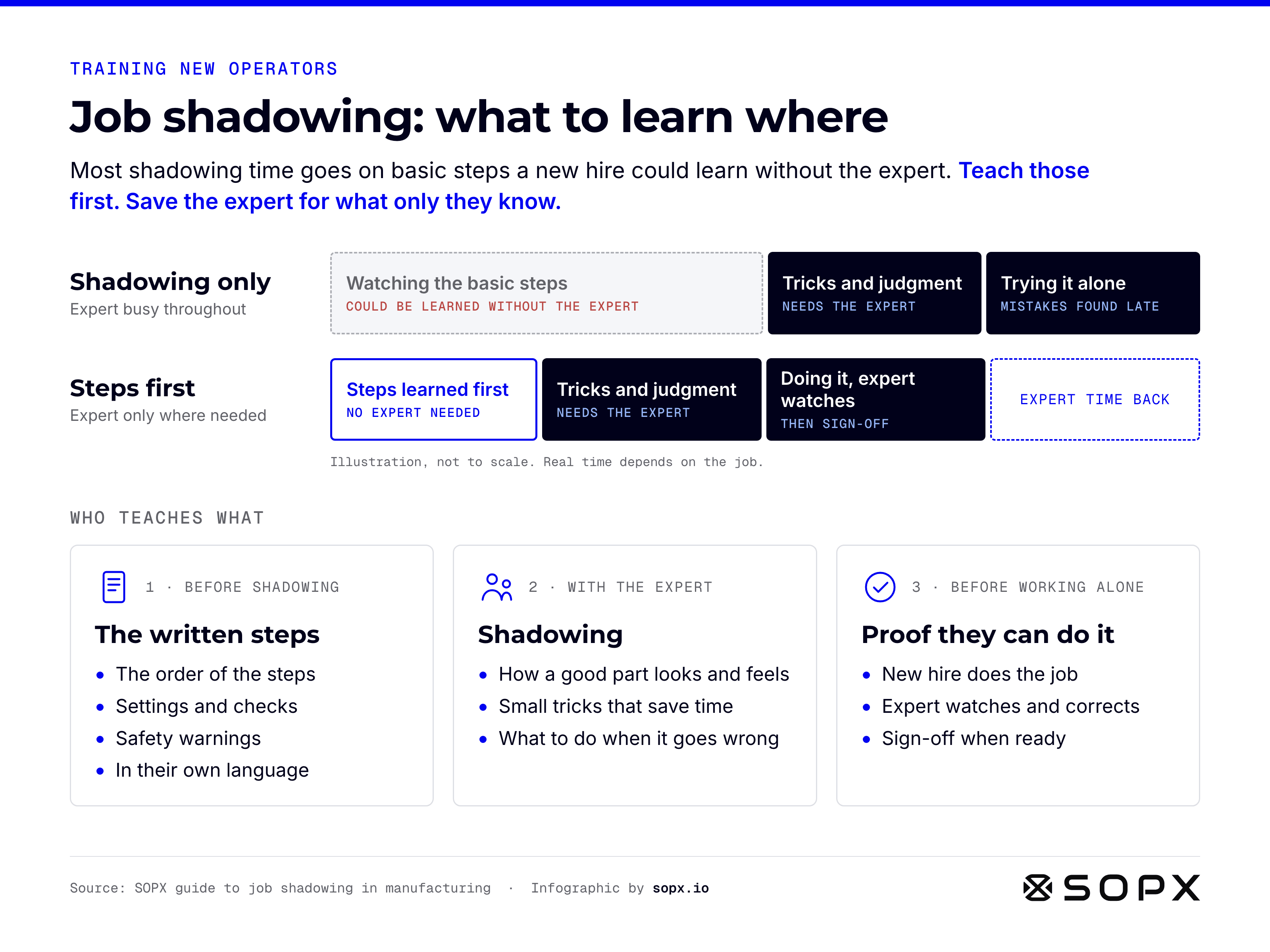
A better question is: how much of the shadowing time is spent on things the new hire could learn without the expert? For most operator jobs, the basic sequence of steps is a big part of it. Move that part out of shadowing, and the time with the expert goes to what only the expert can teach.
What to learn from the steps, and what to learn by shadowing
Split every job into three parts. Each part has a different best teacher.
| Part of the job | Best way to learn it | Examples |
|---|---|---|
| The written steps | Before shadowing, from an SOP or video | The order of the steps, settings and checks, safety warnings |
| Judgment and feel | Shadowing the expert | How a good part looks and feels, small tricks that save time, what to do when it goes wrong |
| Proof they can do it | Reverse shadowing and sign-off | The new hire does the job, the expert watches and corrects, then signs them off |
When shadowing is the whole method, the expert spends most of their time on the first part. That is the part a new hire could learn without them. Teach it first, and the expert’s time goes to the second and third parts, where only they can help.
How to make job shadowing work in 6 steps
1. Pick the tasks and the trainer
List the tasks the new hire must learn, in the order they need them. For each task, pick one trainer who does it the way you want it done. Every task gets one agreed method.
2. Capture the steps before the first shadowing shift
Write down the steps for each task, or better, film the trainer doing it once. For each step, note the key point (what makes it right) and any safety warning. This is the version every trainer will teach from.
3. Give the new hire the steps first
Before they stand next to the trainer, the new hire reads or watches the steps. Now shadowing has a script. They know what to look for and which questions to ask.
4. Shadow with the steps in hand
During shadowing, the trainer follows the same steps. The new hire checks each one off. Where the trainer does something that is not in the steps, update the steps. That is tribal knowledge coming out.
5. Reverse the roles
After a few runs, the new hire does the job and the trainer watches. This is called reverse shadowing. The trainer corrects mistakes on the spot and confirms each key point.
6. Sign off and keep the steps current
When the new hire can do the task alone, the trainer signs them off on it. Keep a record of who is signed off on what. When the process changes, update the steps and retrain the people who learned the old version.
Job shadowing checklist
Copy this into your onboarding plan:
| Before shadowing | During shadowing | After shadowing |
|---|---|---|
| List the tasks to learn, in order | Trainer follows the agreed steps | New hire runs the task, trainer watches |
| Pick one trainer per task | New hire checks off each step | Trainer confirms each key point |
| Capture the steps, with key points and safety warnings | Note anything the steps are missing | Sign off the task |
| Give the new hire the steps in their language | Update the steps the same day | Record the sign-off |
| Agree who the new hire asks for help | Show at least one problem or exception | Retrain when the steps change |
Where SOPX fits
SOPX does steps 2, 3, and 6 for you. The rest stays with your trainers.
- Capture: film the trainer doing the task on a phone. AI turns the video into a step-by-step SOP with a trimmed clip on every step, in about 10 minutes.
- Language: translate the SOP into 50+ languages, so each new hire reads it in their own.
- At the machine: the new hire opens the SOP on a phone or tablet, or from a QR code at the station, and rewatches any step.
- Sign-off: put the SOPs in a training path, assign it to the new hire, and see when they sign off on each one. When the SOP changes, the people who learned the old version can be asked to sign again.
Shadowing doesn’t go away. It gets shorter, because the expert’s time goes to the parts only they can teach. For the wider onboarding picture, see employee onboarding with SOPs.
Frequently Asked Questions
What is the difference between job shadowing and on-the-job training?
Job shadowing is watching an experienced worker do the job. On-the-job training is the full process at the real workstation: watching, practicing under supervision, and being signed off to work alone. Shadowing is one step inside on-the-job training.
What is reverse shadowing?
Reverse shadowing means the new employee does the job while the experienced worker watches. It is the step where mistakes get caught and corrected. It usually comes after a few rounds of normal shadowing.
Can video replace job shadowing?
Not fully. Video is very good at showing the sequence of steps and what “right” looks like. Shadowing is still needed for judgment, feel, and practice with feedback. The best results come from both: video for the steps, shadowing for the practice.
How do you shadow when the trainer and new hire speak different languages?
Give the new hire the steps in their own language before shadowing starts. Short clips on each step help even more, because the action is the same in every language. Then shadowing time goes to practice.
What is the difference between job shadowing and cross-training?
Job shadowing usually trains a new hire for their first role. Cross-training trains people who already work in the plant to cover other roles. Both use shadowing, and both get faster when the steps are written down first.