


Record a process. Get a structured SOP in minutes.
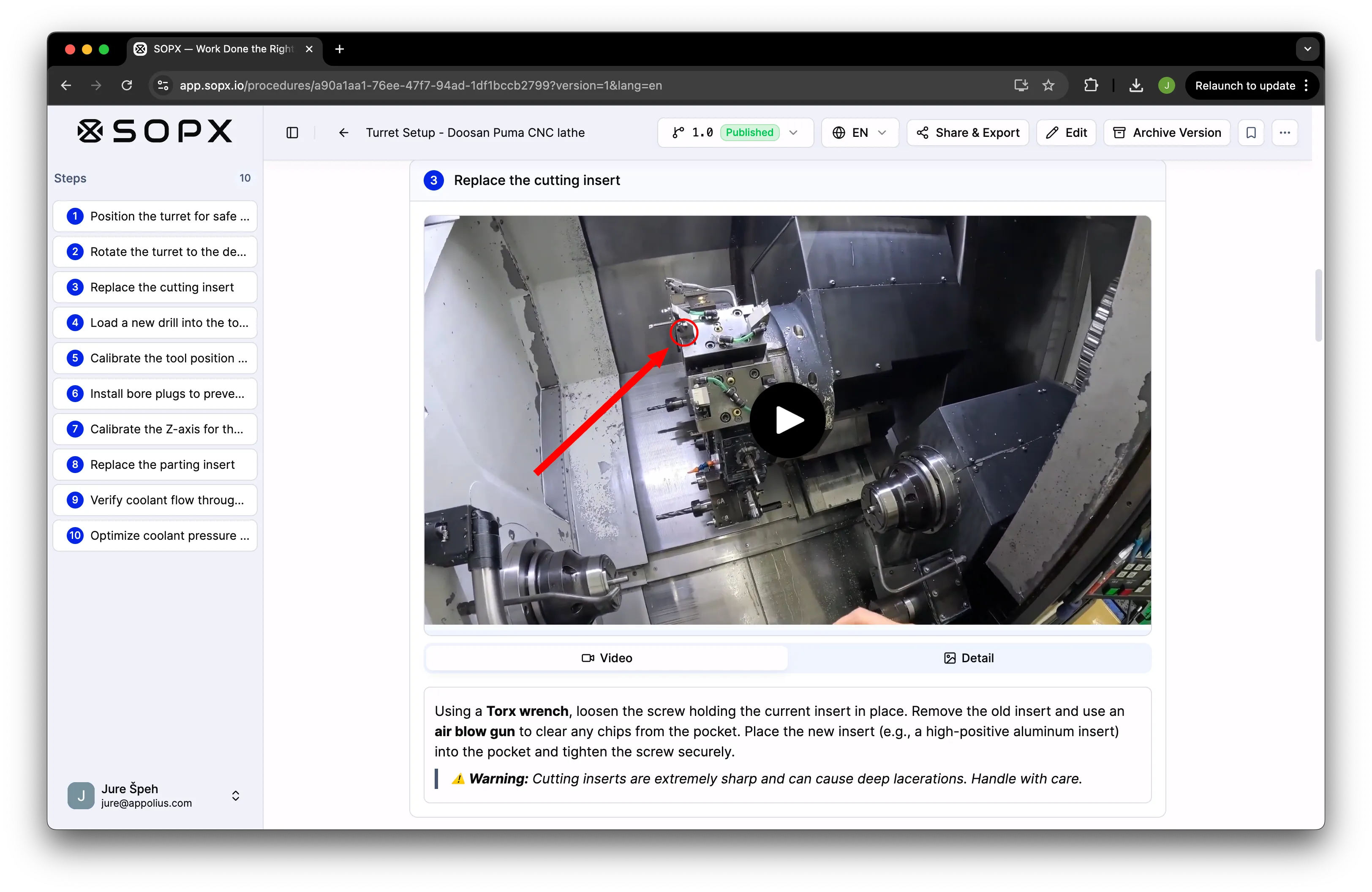
Video SOP software turns a process recording into a structured, step-by-step SOP, and AI writes each step from the footage. Film any process on a phone or screen recording, and AI turns it into a SOP where every step has a trimmed clip, a title, and a description. No writing, no editing software. Then edit it, translate it into 50+ languages, version it, and share it by link or QR, all in one workspace.
- 1 Record the process on a phone
- 2 AI extracts the steps, clips, and screenshots
- 3 Review and edit the draft
- 4 Publish and share by link or QR code
What is video to SOP software?
Video to SOP software turns a process recording into a structured, step-by-step standard operating procedure. You upload a phone video or a screen recording, and AI writes each step with a trimmed clip, a title, and a written description. Work that took hours of typing becomes a publishable draft in under 10 minutes.
The category exists because most work is easier to show than to write. An experienced operator can run a machine setup in four minutes but needs two hours to document it properly. Recording is the fast part. Turning that recording into something a new hire can actually follow is the part the software is for.
The dividing line between tools is what the camera can see. Screen recorders capture clicks inside a browser, so they suit software workflows and stop at the door of a production line. Video to SOP software takes footage of physical work, which is why it fits manufacturing, food production, field service, and warehousing. If every process you document happens on a screen, a screen recorder is the cheaper answer.
The Problem
Writing SOPs by hand never gets done
Your team has 20 procedures to document and no time to write them. Doing it by hand means hours of typing, screenshotting, and sequencing per SOP, so it slips every quarter and the know-how stays stuck in people's heads.
A recording is not a SOP yet
You can record a senior operator running a process in minutes. But raw footage is not something a new hire can follow step by step, and turning it into a structured procedure by hand takes hours. So nobody does it.
Process videos sit unused on shared drives
You filmed the process for a reason. Without structured steps, the clip gets buried in a SharePoint folder and nobody opens it again. The knowledge is captured but not usable.
New hires learn by shadowing, so two people stop working
Without a procedure to follow, every new starter needs a senior operator beside them. That removes your most productive person from the line for days, and each new hire learns a slightly different version of the job.
The people who know the process are leaving
Experienced operators retire or move on, and the detail they carry goes with them. Filming the work while they are still on the floor is the cheapest form of insurance, but only if the footage becomes a procedure someone can follow.
Every shift runs the job a little differently
Three operators do the same task three ways, and the differences only surface as scrap, rework, or a quality hold. Without one agreed version written down, there is nothing to train against and nothing to audit.
How SOPX Helps
from recording to published SOP
Video SOP software that builds every step from your recording
Upload the footage. AI splits it into discrete steps, each with a trimmed video clip, a title, and a description. You get a working draft the moment it finishes, fully editable from there.
blank pages to fill
Start from a draft, not a blank page
Every generated SOP is editable. Adjust step titles, rewrite descriptions, swap a clip, add images, or annotate a frame with arrows and callouts. You refine a draft instead of starting from nothing.
languages, plus versioning and Run mode
One workspace for every SOP after it is made
Published SOPs live in a searchable library your whole team can open by link or QR. Translate into 50+ languages, keep versions as procedures change, and add forms and checklists with signatures in Run mode so you have proof each step was followed.
How It Works
Film the process with a phone
Record an experienced operator running the procedure. No studio, no special hardware, no prep. A phone video or a screen recording is enough.
Upload it and AI builds the SOP
AI splits the recording into discrete steps, each with a trimmed clip, a title, and a description. The full draft is ready in minutes.
Review, publish, and share
Adjust any step, swap clips, add images. Publish to your library and share with the team by QR code or link. Translate and version it whenever the process changes.
Documenting real work: by hand vs screen recorder vs SOPX
How the three common ways to make a SOP compare when the work happens off the screen.
| By hand | Screen recorder | SOPX | |
|---|---|---|---|
| Captures physical, off-screen work | Only if you type it all out | No, on-screen clicks only | Yes, film the real task |
| Who writes the steps | You write every step | You caption each click | AI drafts every step |
| Time to a finished SOP | Hours per procedure | Fast for software only | Under 10 minutes |
| Translation for the floor | Manual, rarely done | English only | 50+ languages |
| Keeping it current | Re-type by hand | Re-record the flow | Edit once, version history |
| Getting it to the floor | Printed binders | Shared link | Link or QR, no login |
| Proof the step was actually done | Paper sign-off sheet | None | Run mode forms and signatures |
| Works from footage you already have | Re-typed by hand | No, must re-record | Yes, upload existing video |
Keep Reading
How to turn existing videos into SOPs
The how-to cut. Three methods compared, with the hours each one costs per 10-minute recording.
Learn more →Best AI SOP software in 2026
If you are comparing named tools rather than deciding on the category, this ranks six of them hands-on.
Learn more →Convert training videos to SOPs by hand
The manual method in full, with a structuring framework and a free template.
Learn more →SOP software
The wider category, for when video is only one of the ways you need to capture work.
Learn more →SOPX vs Scribe
How filming physical work compares with a browser extension that records clicks.
Learn more →Turn an existing PDF into a SOP
If the procedure is already written and stuck in a PDF, import it instead of filming it.
Learn more →Industries Using This
Manufacturing
Film any shop floor process with your phone. AI creates a structured work instruction in under 10 minutes. Organize by production line or department. Operators open the right work instruction at the workstation with a QR code, in their language.
Learn more →Food Production
Film sanitation, production, and quality procedures. Upload existing HACCP documentation as PDFs. AI creates structured, versioned SOPs. Organize by area. Every worker reads procedures in their language.
Learn more →Logistics & Warehousing
Film picking, packing, receiving, and shipping procedures. AI creates structured SOPs in minutes. Organize by warehouse zone or facility. Seasonal hires access procedures from shift one with a QR code.
Learn more →Field Service
Film any installation, repair, or maintenance task with a phone. AI generates a structured SOP. Technicians open it on mobile at the customer site, in their language.
Learn more →Healthcare
Film bedside, lab, or front-desk procedures with a phone. AI generates a structured SOP in minutes. Each clinician sees the procedure for their unit, in their language, accessible at the point of care.
Learn more →Retail & Hospitality
Film housekeeping, front desk, kitchen, and service procedures. AI creates structured SOPs in minutes. Organize by department. Housekeeping sees housekeeping procedures. Kitchen sees kitchen procedures. Train multilingual teams in their language.
Learn more →Related Use Cases
Knowledge Capture
SOPX is tribal knowledge software: record your experts doing the tasks they already do every day, and AI turns the footage into structured, shareable SOPs. The expert keeps working, not authoring docs.
Learn more →Training & Onboarding
Upload a process video. Get a step-by-step SOP in minutes. New hires train independently with visual procedures. No more weeks of shadowing.
Learn more →Process Standardization
Process variation drives quality issues, waste, and errors. Standardize every task with visual SOPs generated from your best methods, accessible at every workstation.
Learn more →Work Instructions for Training
Turn a process video into a visual, step-by-step instruction a new starter works through at their own pace. Any device, any language, no shadowing required.
Learn more →Built for These Roles
Operations Manager
You do not have hours to write procedures, and your best operators should not either. They film the job on a phone, AI drafts a clear step-by-step SOP, and you review it in minutes. The line keeps running when someone is out.
Learn more →Plant / Site Manager
Quality slips when every operator runs the process their own way. Film a machine setup once, let AI draft a step-by-step work instruction in minutes, and publish it so the line runs the same on every shift.
Learn more →Production Supervisor / Team Lead
You answer the same questions every shift, and your best operators lose time to it too. Film the job once, let AI draft a step-by-step visual work instruction, and point your team to one link they open right at the workstation.
Learn more →Training & L&D Manager
Your best people do not have hours to write training docs, and they should not have to. Film the expert doing the task, let AI draft a step-by-step guide in under 10 minutes, and give new hires the real method to study before they start.
Learn more →Quality Manager
Defects and variation come from work done a different way every time. Have your best operator film the correct method, let AI draft the procedure, and control which version the floor runs.
Learn more →Documentation / SOP Coordinator
You keep the SOP library built, current, and in everyone's hands. Stop staring at a blank page and chasing SMEs. Film the expert once or import the PDFs you have, let AI draft the SOP, and run document control from one searchable place.
Learn more →