

Guides ·
SOP Periodic Review: How Often and What to Check
How often to review SOPs and work instructions, which rules require it (ISO 9001, HACCP, GMP, OSHA PSM), what triggers a review, and a checklist for doing one.


Periodic Review (SOPs) definition
TL;DR
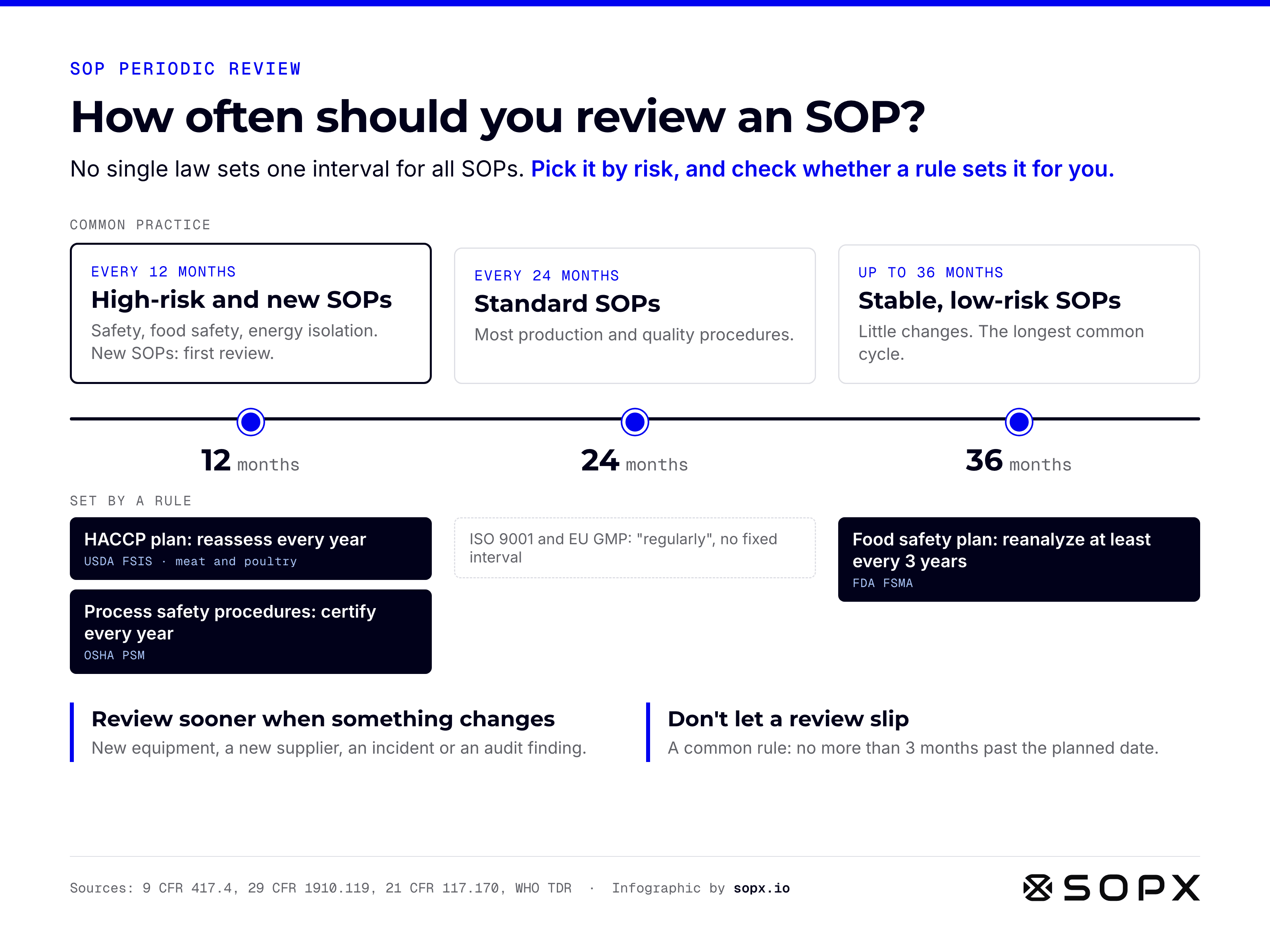
An SOP periodic review is a short, scheduled check that a procedure still matches the job. No law sets one interval for all SOPs. Most teams review every one to two years. They review high-risk procedures every year. Some rules set their own cycle. A meat or poultry HACCP plan is checked every year. OSHA process safety procedures are confirmed every year. An FDA food safety plan is checked at least every three years. Review sooner when something changes. Every review ends with a record: still correct, a new version, or retired.
- Procedures go out of date quietly. Equipment, suppliers, people and rules change, and nothing tells you the document is now wrong.
- Pick an interval by risk: about 12 months for high-risk and new SOPs, about 24 months for the rest.
- Don’t wait for the date after a new machine, an incident, an audit finding or a rule change.
- A review is only real if you record what you checked, who checked it, and when the next one is due.
Download the SOP periodic review checklist and review log (Word) or as a PDF.
”When was this procedure last reviewed?”
It’s the first question an auditor asks about a procedure, and often the hardest one to answer. Most teams need an afternoon with a spreadsheet to find out. For many SOPs, the honest answer is “not since we wrote it”.
Here is how it happens. A plant buys valve gaskets from a new supplier. The new gasket needs a different torque. The mechanics learn it on the job. The SOP still shows the old part and the old number. Nobody broke a rule. Nobody looked.
Six months later, a new mechanic follows the SOP exactly. The valve leaks.
Why SOPs go out of date without anyone noticing
A procedure is correct on the day it’s approved. From then on, the work around it keeps moving:
- Equipment changes. A machine is replaced, moved or modified. The buttons, guards and settings in the photos no longer match.
- Materials change. A new supplier, a new part or a new chemical can change settings, checks and safety steps.
- People find better ways. An experienced operator finds a faster sequence. It becomes the real method, but it never gets written down. That gap is called process drift.
- Rules and customers change. A new standard or a customer requirement makes an old step non-conforming.
Most document control only reacts to change requests. If nobody asks for a change, nobody checks the document. A procedure nobody touches can stay wrong for years.
Printed copies make it worse. A sheet taped to a machine stays the same while the controlled version moves on. That is why many document control procedures mark printed copies as uncontrolled. A QR code at the station that always opens the current version avoids the problem.
The cost shows up later. New hires learn the wrong version. Audits find stale documents. And once operators catch one wrong SOP, they stop trusting the rest. For the content side of the problem, see keeping work instructions up to date.
What is an SOP periodic review?
An SOP periodic review is a scheduled check that a procedure is still accurate, complete and safe to follow. The owner compares it with the job as it is done today. Then they record the result.
A periodic review is not a rewrite. Most reviews end with “no changes needed”, and that is a good outcome, as long as it is recorded. A due review also doesn’t take the procedure offline. People keep using it while it’s checked.
Periodic review vs change control. Change control handles changes someone asks for: a new machine, a new supplier, a corrective action. Periodic review catches the changes nobody asked for. You need both.
How often should SOPs be reviewed?
No law sets a single review interval for all SOPs. Most quality teams review standard procedures every one to two years, and high-risk procedures every year. Set a default for your organization, then make it shorter for procedures where a mistake is costly or unsafe.
| Procedure type | Typical interval | Why |
|---|---|---|
| High risk: safety-critical tasks, food safety, energy isolation, sterile work | Every 12 months | A mistake hurts people or product |
| New SOPs | First review within 12 months | The gaps show in the first year of use |
| Standard production and quality SOPs | Every 24 months | Common practice in quality and GMP systems |
| Stable, low-risk procedures | Every 24 to 36 months | Little changes |
| Covered by a rule with its own cycle | The rule’s cycle | See the next section |
Two practical rules help. First, review a new SOP within its first year, because that is when missing steps show up. Second, don’t let a review slip far past its date. One published example of an SOP management procedure, from WHO TDR, sets a review cycle of one to three years by risk and says a review should not happen more than three months after the planned date (WHO TDR, SOP management example).
Shorter is not always better. Set every SOP to six months and reviews pile up. People start ticking boxes without checking. A cycle that gets done beats a strict one that gets rubber-stamped.
Which rules require SOP reviews?
Some standards and regulations ask for regular review in general terms. A few set a fixed cycle for specific documents. Here are the ones most relevant to manufacturing and food plants.
| Rule | What it asks for | What it means in practice |
|---|---|---|
| ISO 9001:2015, clauses 7.5.2 and 7.5.3 | Documents are reviewed and approved for suitability and kept suitable for use | No fixed interval. A review cycle is how most teams show their procedures stay suitable. See what ISO 9001 requires for SOPs |
| ISO 13485:2016, clause 4.2.4 | Review, update as necessary and re-approve documents | Since 2 February 2026, the FDA’s Quality Management System Regulation for medical devices incorporates ISO 13485 by reference |
| EU GMP, EudraLex Volume 4, Chapter 4.5 | ”Documents within the Quality Management System should be regularly reviewed and kept up-to-date” | Regular review is expected for GMP documents |
| US drug GMP, 21 CFR 211.100 | Written procedures, and changes to them, are reviewed and approved by the quality control unit | No fixed interval for SOPs |
| OSHA Process Safety Management, 29 CFR 1910.119(f)(3) | Operating procedures are reviewed as often as necessary, and the employer certifies every year that they are current and accurate | A dated, yearly confirmation for covered processes, such as large ammonia refrigeration systems |
| USDA FSIS HACCP, 9 CFR 417.4(a)(3) | The HACCP plan is reassessed at least once a year and whenever changes could affect it, and each reassessment is recorded, including the reasons for not changing the plan | A “no changes” result must be written down too |
| FDA food safety plans (FSMA), 21 CFR 117.170 | The food safety plan is reanalyzed at least once every three years, and sooner after significant changes | The SOPs behind the plan should keep pace |
ISO 22000 and ISO 45001 use the same documented information structure as ISO 9001. Your certification body, customer or regulator may ask for more. Check your own document control procedure first.
Sources: eCFR 21 CFR 211.100, eCFR 9 CFR 417.4, 21 CFR 117.170, OSHA 1910.119, EU GMP Chapter 4, FDA QMSR.
When should you review an SOP before its date?
The review date is a safety net. The best reviews happen because something changed. Review a procedure now when:
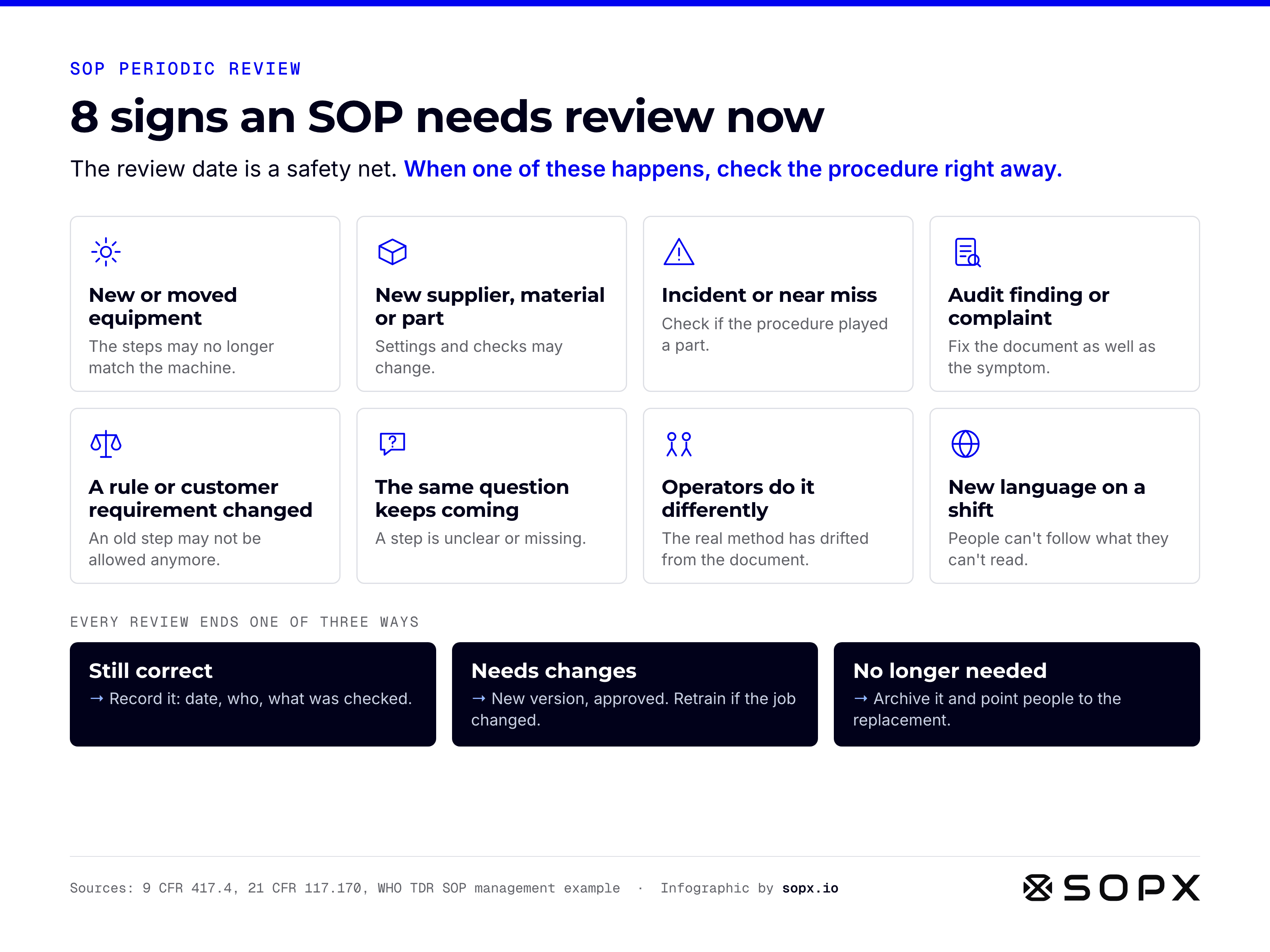
- New or moved equipment. The steps may not match the machine anymore. After a line changeover project or a new machine, check every procedure that touches it.
- A new supplier, material or part. Settings, checks and safety steps may change.
- An incident or near miss. Check whether the procedure played a part.
- An audit finding, deviation or complaint. Fix the document as well as the symptom.
- A rule or customer requirement changed. An old step may now be non-conforming.
- The same question keeps coming up. The procedure is unclear or missing a step.
- Operators do the task differently. The real method has drifted away from the document.
- A new language on a shift. People can’t follow what they can’t read.
The people on the floor see most of these first. Make it easy for anyone to flag a problem with a procedure, for example with a comment on the procedure, and make sure the owner sees it.
How to run a periodic review: a checklist
Most reviews are quicker than people expect, because most end with “no changes”. Use this checklist:
| # | Step | What to look for |
|---|---|---|
| 0 | Gather what happened since the last review | Deviations, complaints, incidents, audit findings, equipment or supplier changes, questions from the floor |
| 1 | Walk the job with the procedure open, or watch the person who does it daily | Does the real task follow the document? |
| 2 | Compare step by step | Order, settings, tools, parts, quality checks |
| 3 | Check safety | Hazards, PPE, lockout points, warnings still correct |
| 4 | Check the pictures | Photos and clips still show the current machine and parts |
| 5 | Check every language version | Translations match the source |
| 6 | Decide | Still correct, needs a new version, or no longer needed |
| 7 | Record the result | Date, who reviewed, outcome, what you checked, next review date |
| 8 | If there is a new version | Decide who needs to retrain on it |
Step 7 is where most reviews fail. Ticking a box or changing a date does not show that anyone checked the procedure. A short note does: “Checked against this week’s walk-arounds. All 8 steps still match.”
The free download has this checklist on page 1 and a blank review log on page 2, to print or fill in:
Download the checklist and log (Word) · Download the PDF
What a review record should show
Whether you keep it on paper or in software, a review record answers the auditor’s question in seconds:
| Field | Example |
|---|---|
| Procedure and version | WH-INS-003, Delivery truck walk-around inspection, version 1.0 |
| Owner | Alex Morgan |
| Why it was reviewed | Scheduled (every 3 months) |
| What was checked | Compared with this week’s walk-arounds |
| Outcome and reason | No changes needed |
| Approved by | Priya Nair, QA lead |
| Date and next review | 13 Nov 2026, next review 13 Feb 2027 |
The classic way is a paper review log at the back of each SOP: version, review date, revision required yes or no, and the reviewer’s signature. It works, but only if someone remembers to fill it in.
Why periodic reviews slip
Most teams don’t skip reviews on purpose. The system makes them easy to miss:
- The dates live somewhere else. Review dates sit in a spreadsheet next to the document system. Someone has to remember to open it.
- Owners get chased by hand. A quality lead sends reminder emails, then follows up, then follows up again.
- The evidence is filed somewhere else. The review happened, but the record sits in an email or a binder, away from the procedure.
- Owners leave. When a procedure owner changes jobs, their reviews quietly fall through.
A due date that nobody sees is the same as no date at all.
How SOPX runs periodic reviews for you
SOPX keeps the review date, the reminder and the record on the procedure itself.
Set how often. An admin sets Review every (3, 6, 12 or 24 months) as the organization default. Each procedure can follow it or use its own interval. Nothing changes until you turn it on, and a procedure already past its interval becomes due today, so you don’t start with a wall of overdue reviews.
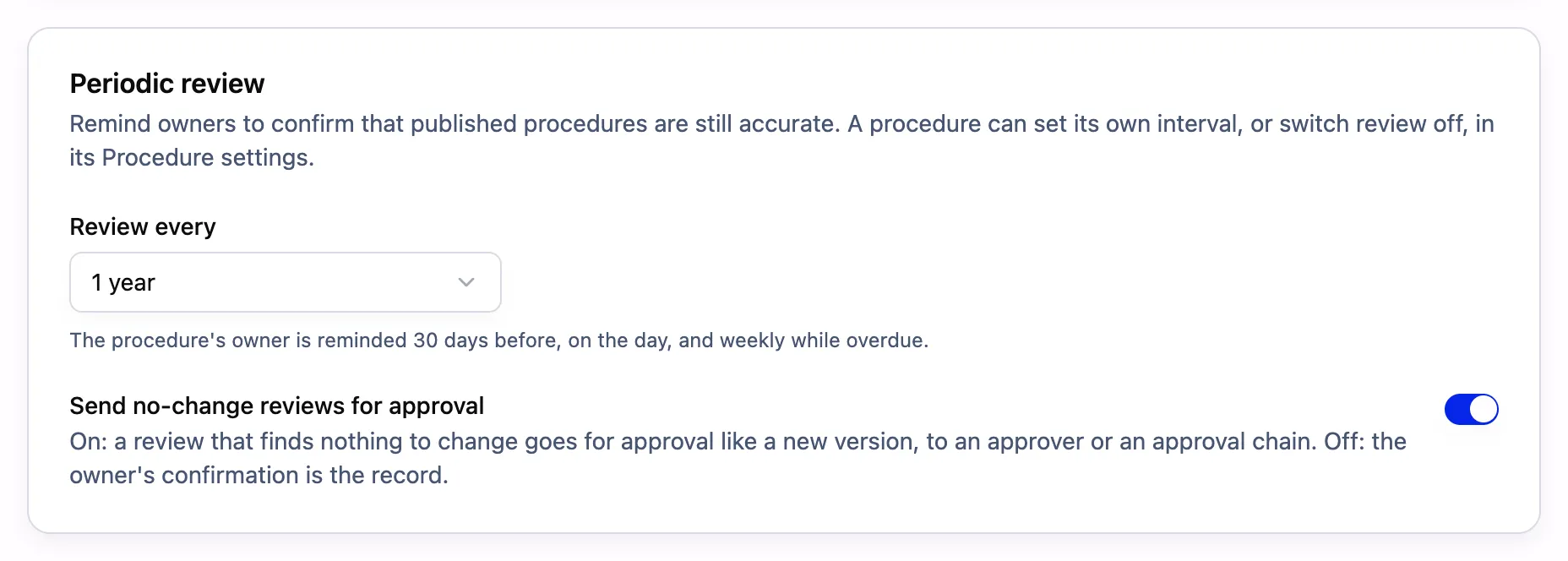
Set one review cycle for the whole organization, and change it per procedure where risk calls for it.
The owner gets reminded. From 30 days before the due date, the procedure shows a banner to its owner: “Periodic review: due in 17 days. You own this procedure. Check that version 1.0 is still accurate.” Reminders also go out in the app and by email: 30 days before, on the day, and every week while overdue. Due reviews show under Reviews due on Home and in My Reviews. The procedure stays published the whole time. Operators keep running it.
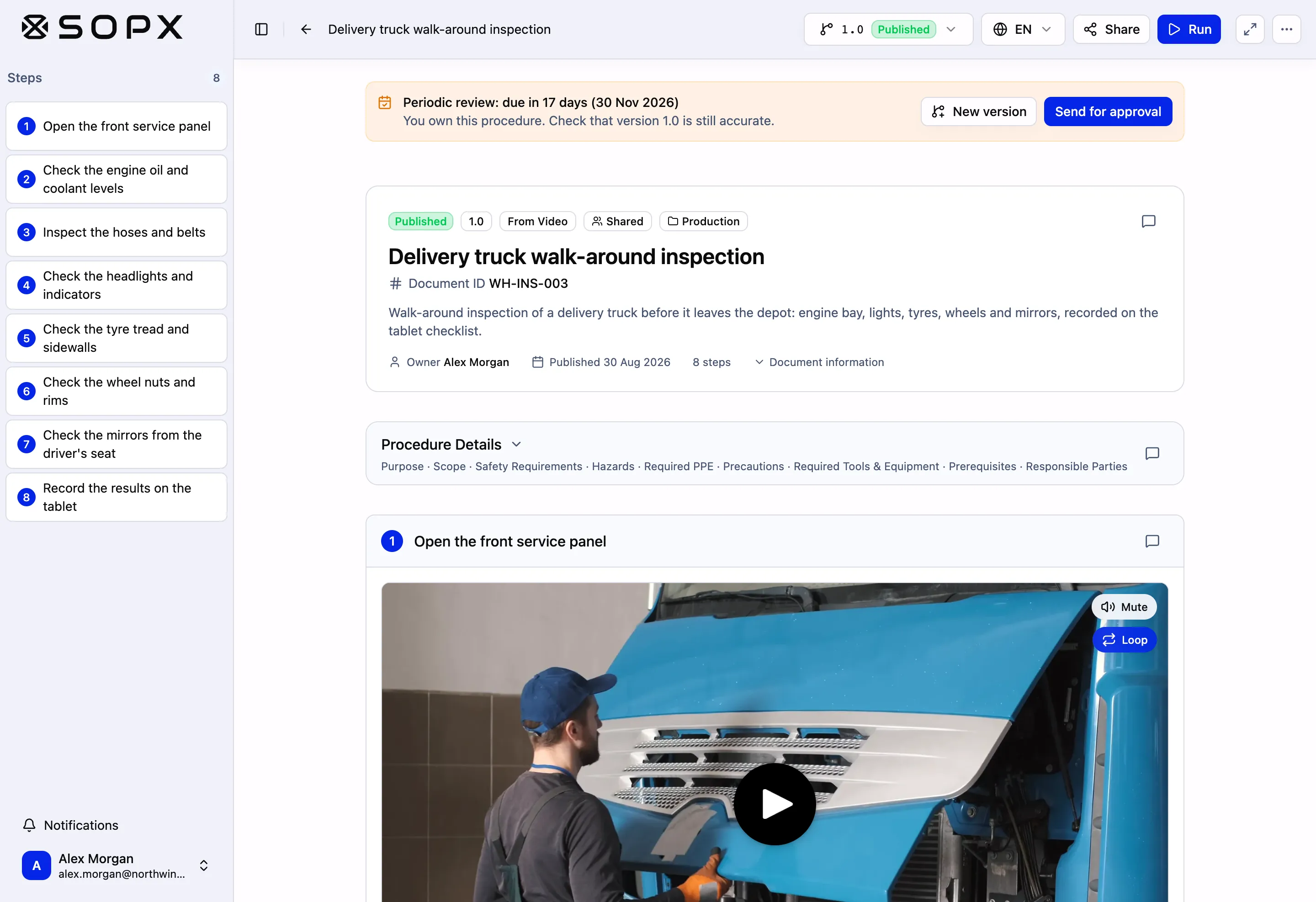
The reminder sits on the procedure, with the two possible outcomes one click away.
Two honest outcomes. If nothing changed, the owner chooses Confirm review, or Send for approval if your organization wants an approver to sign off every review. The review goes to a single approver or an approval chain, with separation of duties so nobody approves their own review. The owner adds a note on what was checked. If something changed, the owner starts a New version instead. Publishing it completes the review.
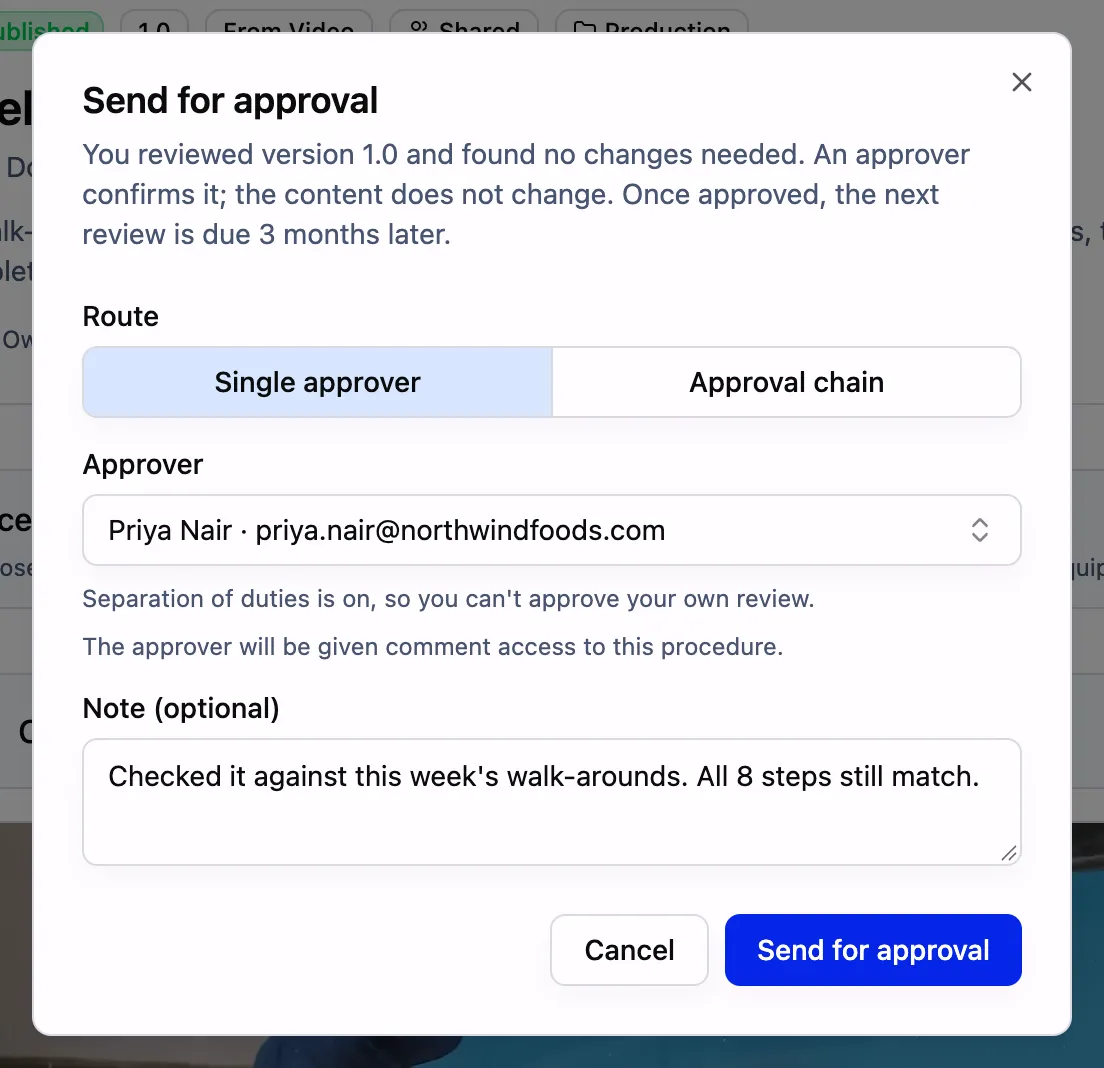
A no-change review uses the same approvers and approval chains as a new version.
The record answers the auditor. Every procedure shows Last reviewed (date, outcome, who sent it, who approved it) and Next review (date and cycle) in its document information. Each step is also kept in the procedure history, and the review dates print on exported PDF, Word and PowerPoint covers.
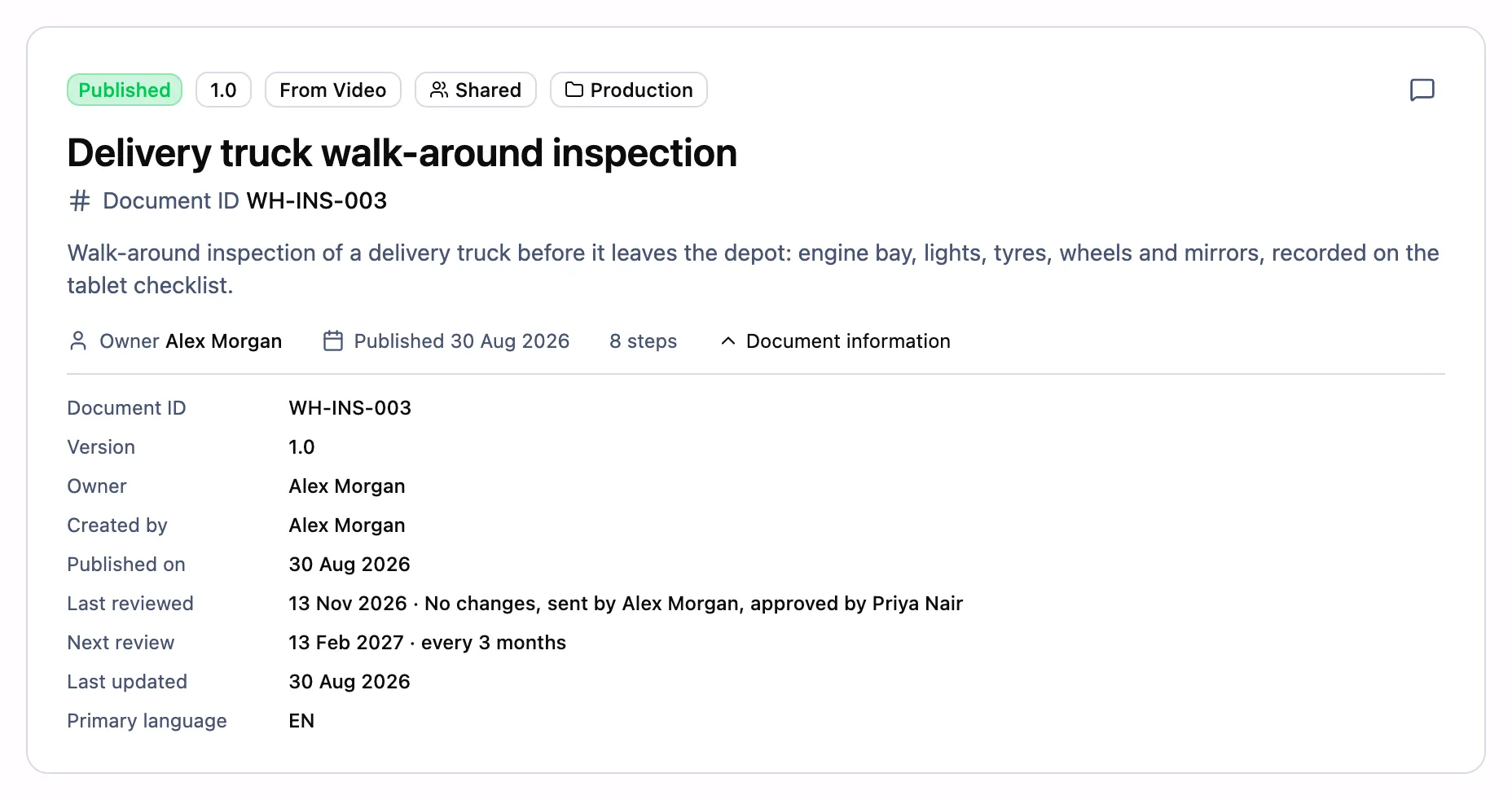
Last reviewed and Next review, on the procedure itself.
Oversight for admins. The All reviews list shows every review waiting on someone across the organization, with overdue ones in red. If an owner has left, an admin can confirm the review or transfer ownership. An admin can also Request an update with a note when they know a procedure is out of date.
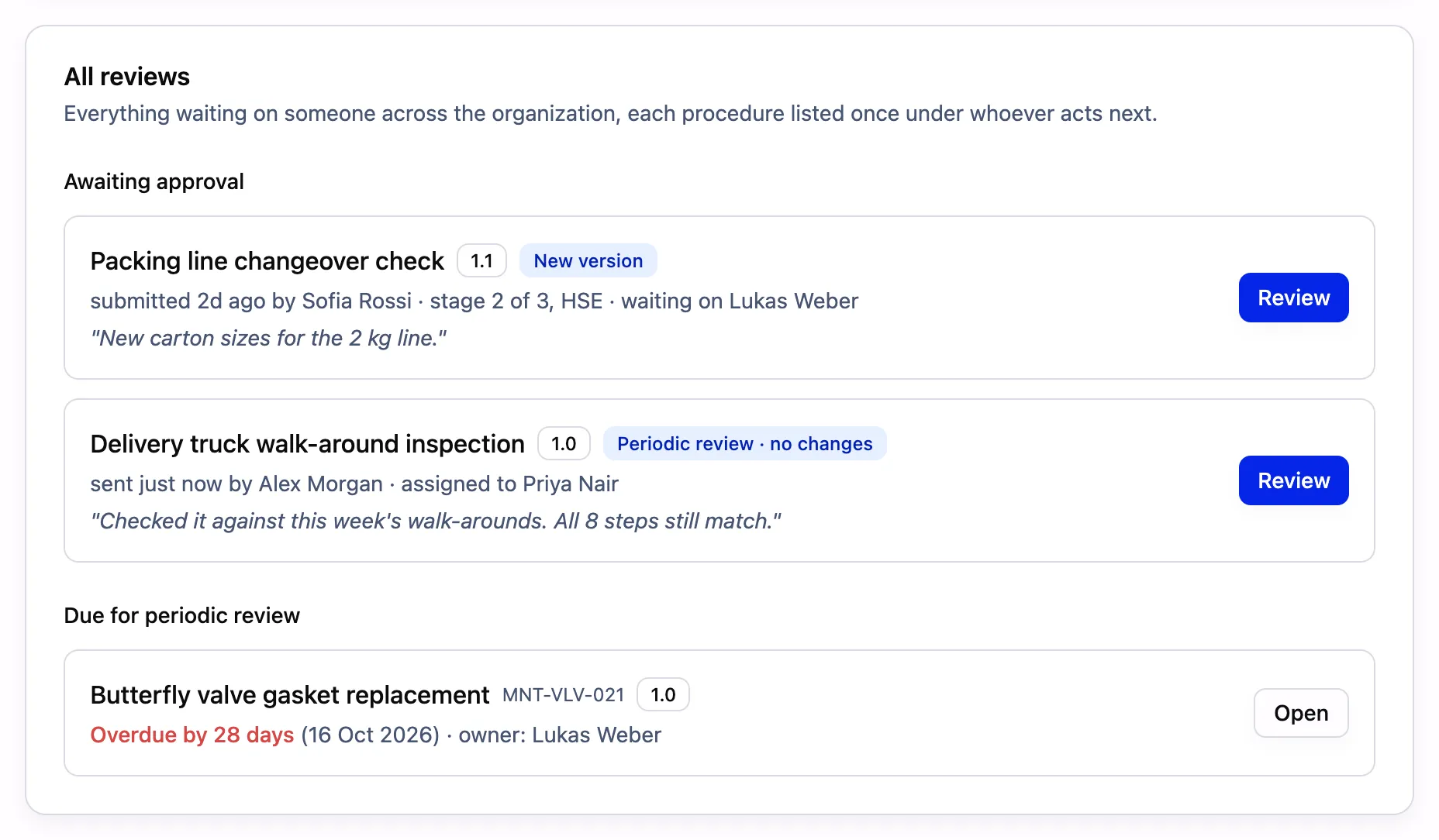
Every review across the organization in one list, under whoever needs to act next.
A review with no changes never asks people to retrain. When a new version is published, you choose who needs to retrain on it.
Periodic review is included with approval flow on the Standard, Premium and Enterprise plans, and in the free trial. Sending reviews through an approval chain needs Premium or Enterprise. See pricing.
What to show an auditor
When the auditor asks about a procedure, you want three things on one screen:
- When it was last reviewed, by whom, and what the outcome was.
- When the next review is due.
- The history: every review and every version, with dates and names.
This helps you show that each procedure is still suitable and was checked on the cycle you set. It supports what ISO 9001 and ISO 13485 ask for in document control. It doesn’t replace your own document control procedure. Software alone doesn’t meet a standard for you.
Frequently Asked Questions
What is an SOP periodic review?
An SOP periodic review is a scheduled check that a standard operating procedure still matches how the job is done today. The owner compares the procedure with the real task, then records the result: still correct, a new version, or no longer needed.
How often should SOPs be reviewed?
No law sets one interval for all SOPs. Most quality teams review standard procedures every one to two years and high-risk procedures every year, and review new SOPs within their first year. Some rules set their own cycle, such as a yearly HACCP plan reassessment for meat and poultry plants.
Does ISO 9001 require an annual SOP review?
No. ISO 9001 asks that documents are reviewed and approved for suitability and stay suitable for use, but it sets no review interval. A regular review cycle is the usual way to show an auditor that procedures stay suitable.
What is the difference between periodic review and change control?
Change control handles changes someone asks for, such as a new machine or a corrective action. Periodic review is a scheduled check that catches the changes nobody asked for, like a workaround that became the real method.
What if a review is overdue?
Review the procedure now and record the real date. Don’t backdate it. The procedure can usually stay in use while you check it, unless you already know it is wrong or unsafe. Some document control procedures set a grace period, such as three months, so a late review gets attention before it is forgotten.
Do people need to retrain after a periodic review?
Not if the review found no changes. Retraining makes sense when the review leads to a new version that changes how the job is done. Then choose who needs to retrain on the new version.
Who should review an SOP if the owner has left?
Assign a new owner first, ideally someone who does or supervises the task. Until then, the quality lead or an admin should complete the review so it doesn’t fall through.