

How to Capture Tribal Knowledge Before It Retires

As experienced workers retire, decades of tribal knowledge walk out the door. A practical playbook for capturing process know-how before it leaves, and why it is worth more in the AI era.
TL;DR
Capture tribal knowledge on video before experienced workers retire, because AI tools can only translate, search, and train on what is already documented. Anything trapped in one person’s head stays invisible to every AI assistant, translator, or training system. The retirement wave is a knowledge wave, and captured process knowledge is now a reusable company asset.
- The Manufacturing Institute reports 97% of manufacturing firms worry about losing process knowledge as experienced workers retire.
- Tribal knowledge is process know-how that lives in people, not documents, and disappears the moment its holder changes shift, leaves, or retires.
- Recording an experienced operator on video captures hand position, tool angle, timing, and narration that written documentation usually misses.
- Video-to-SOP software turns a recording into a structured SOP in minutes instead of half a day spent writing in a conference room.
- Documented SOPs unlock AI translation, plain-language search, faster onboarding, and a versioned baseline that tribal knowledge cannot provide.
The retiring workforce is a knowledge wave
The manufacturing and operations workforce is aging. The retiring workforce problem is bigger than the hiring problem behind it. The Manufacturing Institute reports 97% of manufacturing firms are worried about losing process knowledge as experienced workers retire.
The next decade will pull more institutional know-how out of active employment than any period in recent history.
The problem isn’t finding replacements. Hiring is hard but possible.
The harder problem is that each retiring operator carries decades of undocumented detail no amount of hiring can replace. Setup shortcuts. Failure warning signs. Small adjustments that prevent scrap. The exact sequence that keeps a changeover under twenty minutes.
When that knowledge leaves without being documented, the company pays three times. Once in lost productivity while the replacement ramps up. Once in quality incidents while they learn what not to do. And once in the slow erosion of a process baseline no one can reconstruct, because the person who knew it is no longer there.
What “tribal knowledge” actually means
Tribal knowledge is process know-how that lives in people, not documents. It’s the sum of small decisions, shortcuts, and pattern recognition that experienced workers use without thinking. A new hire can’t perform it. An auditor can’t verify it.
Tribal knowledge is usually accurate because it reflects what works on the floor. It’s also fragile. The moment the person who holds it changes shift, leaves, or retires, it’s gone.
Most ops teams run on a mix of documented procedures and tribal knowledge. The documented portion covers the basics. The tribal portion covers the hard cases, the edge conditions, and the quality-critical moves that separate a good operator from a great one.
Why documented knowledge is worth more in the AI era
Before AI, written SOPs were a compliance tool. They existed for audits, for new hires, and for the occasional refresher. Most of the real work still ran on tribal knowledge, and documenting it felt like overhead.
That math has changed. Captured process knowledge is now a reusable asset:
- Translation. AI translates the SOPs you’ve written. Multilingual operators who can’t read English are locked out of whatever isn’t documented.
- Search. An AI assistant can’t surface the setup shortcut that lives only in one operator’s memory.
- Training. Models that help new hires come up to speed need source material.
- Verification. Quality systems that check whether a step was followed correctly need a reference.
AI amplifies the process knowledge you’ve captured. It ignores the rest. The gap between companies that document their tribal knowledge and the ones that don’t is becoming a competitive gap.
What captured process knowledge unlocks
A documented process library used to sit on a shared drive and collect dust. In an AI-powered operation, the same library powers several things:
- Instant multilingual access. A foreign-language operator reads every SOP in their first language. Twenty procedures become eighty procedures across four languages, at almost no extra cost.
- Onboarding that doesn’t depend on one person. New hires follow the same structured SOPs experienced operators validated. Training time drops because shadowing becomes optional, not the only option.
- Search across the whole operation. An operator asks a plain-language question (“how do we change over the Line 3 filler?”) and the right SOP surfaces in seconds.
- A living baseline for continuous improvement. When a process changes, the documented version updates and every worker sees the latest one. Change history is preserved for audits and root-cause analysis. It’s not a dead PDF in a SharePoint folder.
None of this works without captured knowledge. Tribal knowledge is invisible to every tool in the list.
Four practical ways to preserve company know-how before it leaves
A knowledge retention strategy lives or dies on how cheap it is to execute.
The standard objection to documentation is time. Ops managers know the problem and want the fix, but nobody has four hours per SOP to write from scratch.
The capture methods below are built around that constraint. Each one trades the least floor time for the most knowledge captured.
1. Record experienced operators on video
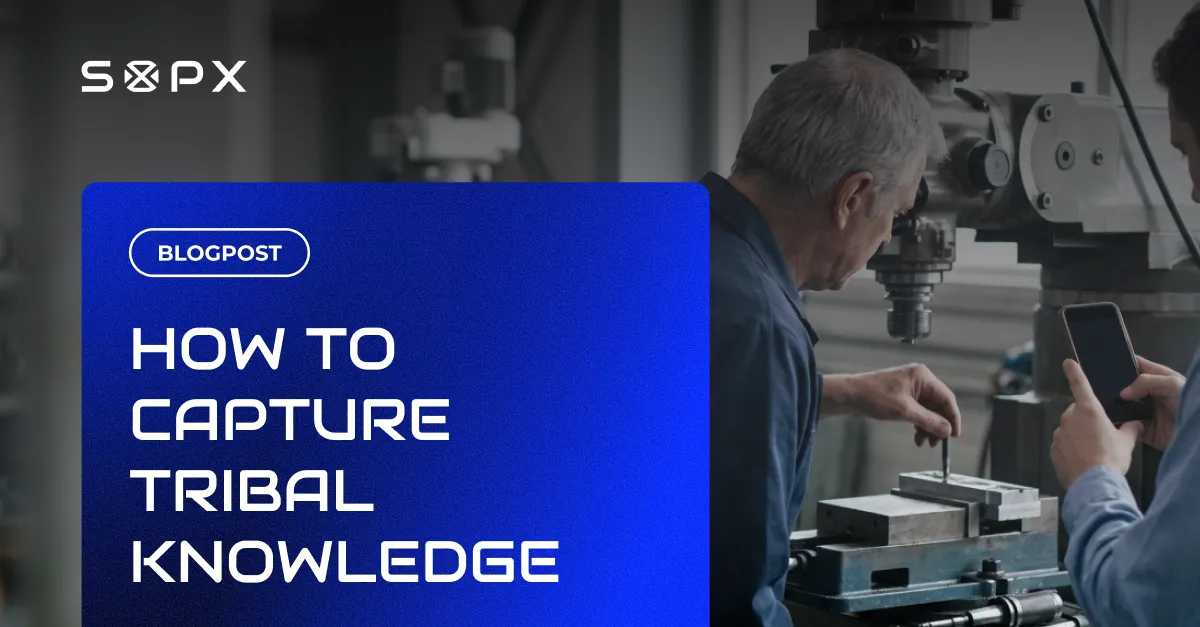
The fastest way to capture tribal knowledge is to record the person who holds it. A phone, a GoPro, or a tripod-mounted camera captures a full process in real time, including the operator’s narration on why each step is done that way.
Video captures more than text. It preserves hand position, tool angle, machine response, and timing.
Video-to-SOP software turns that recording into a structured SOP in minutes. The operator spends ten minutes on camera instead of half a day in a conference room writing. This is exactly what video SOP software is built for.
2. Import legacy PDFs and Word documents
Many teams already have partial documentation in PDFs, scanned binders, or old Word files. That content is knowledge, even if it’s not in a usable format today.
Modern SOP tools can import a PDF and convert it into a structured digital SOP with extracted text, images, and step descriptions. For Word documents, export to PDF first.
Legacy documentation becomes a searchable, translatable starting point instead of a dead file.
3. Create quick manual SOPs for processes without video
Not every process needs video. Short, well-defined procedures can be documented manually in a digital SOP editor with images, carousels, and rich text. Work that used to live in a Word document moves to a platform with versioning, sharing, and translation built in.
Lower the cost of the first draft. Don’t aim for perfection. A rough SOP that exists is worth more than a polished one that doesn’t.
4. Translate captured knowledge into every language the workforce speaks
A single English SOP reaches some of the workforce. The same SOP in four languages reaches all of it.
AI translation of structured SOPs is fast and context-aware. Translating a procedure becomes a matter of minutes, not weeks.
Multilingual capture is where documented knowledge compounds fastest. Every new procedure is instantly available in every language the team operates in.
Three scenarios where the cost of undocumented knowledge shows up
The value of captured knowledge is easiest to see in the moments it’s missing. Three scenarios account for most of the pain.
Scenario 1: The thirty-year operator retires
A senior machinist announces retirement with four weeks notice. The team discovers that the sixty-second adjustment used to keep a specific tool in tolerance was never written down.
After the machinist leaves, scrap rates on that part climb by a third. The company spends six months rebuilding a setup that used to be automatic.
Capturing that operator on video takes thirty minutes. Rebuilding the know-how from scratch takes six months. That’s why video capture has become a standard offboarding step at manufacturers paying attention.
Scenario 2: The night-shift drift
Day shift, swing shift, and night shift all run the same line. Over twelve months, each crew develops its own small variations on a changeover. None are documented because each crew believes their version is the standard.
Quality data shows three different defect signatures on the same product depending on which shift made it.
Without a single documented reference, every investigation has to start by asking each shift what they do. A documented SOP with version history collapses that investigation into minutes.
Scenario 3: The foreign-language workforce
Half of the line operators speak a language other than English. The SOPs exist, but only in English. In practice, the SOPs are ignored and new hires learn by watching whoever’s on shift that day.
Translating the SOPs into the operators’ first language changes the dynamic. The documented knowledge becomes accessible to everyone who needs it. The line stops depending on a handful of bilingual workers to interpret procedures in real time.
This is where captured knowledge pays back fastest. Translating documented content is near-zero cost. Translating tribal knowledge is impossible.
Building a knowledge retention program without slowing production
The teams that run a real knowledge retention program follow a simple sequence. It’s built around one constraint. Production comes first, and documentation can’t stop the line.
- List the ten most fragile processes. Fragile means one person holds most of the knowledge, or a retirement or shift change would cause measurable disruption.
- Capture those processes first. Record the operator who holds the knowledge, or import the closest existing document. Rough first version, not perfection.
- Publish and iterate. Put the captured SOPs in front of operators and supervisors. Collect corrections. The second version will be better than anything a conference room could produce.
- Translate into every language the workforce needs. This is the step that turns captured knowledge from a document into an asset.
- Add version history from day one. When a process changes, SOPX logs it automatically. The SOP library becomes a durable record that compounds.
Most teams that start this way have their top ten fragile processes documented within a month, by fitting capture into normal operations rather than running a dedicated project.
Frequently Asked Questions
What is institutional knowledge?
Institutional knowledge is the accumulated, mostly undocumented know-how that makes an organization run.
It includes process shortcuts, failure warning signs, decision heuristics, customer-specific quirks, and the informal rules experienced employees follow without thinking.
Institutional knowledge is usually accurate and always fragile. It lives in people and disappears when those people leave.
What is the difference between institutional knowledge and tribal knowledge?
They overlap heavily.
“Tribal knowledge” is more common in manufacturing and field operations. It usually refers to process know-how that lives on a team or a shift.
“Institutional knowledge” is broader. It includes organizational, customer, and strategic know-how across the whole company.
Both describe undocumented know-how that needs to be captured before the people who hold it leave.
Why is capturing knowledge more important in the AI era?
AI tools amplify documented knowledge and ignore undocumented knowledge.
Translation, search, onboarding, and verification all need source material the AI can read.
Teams that have captured their process knowledge gain compound value from every AI capability they adopt. Teams that haven’t see those capabilities underperform, because the real knowledge is still trapped in people.
What software helps factories capture tribal knowledge before key employees retire?
The most direct fit is video-to-SOP software. Instead of asking a retiring operator to write documentation they have no time for, you film them performing the process once, and AI structures the recording into a step-by-step SOP in minutes. That captures the hand movements, timing, and small adjustments that text usually misses. Look for a tool that also handles versioning (so the procedure stays current), translation (so the whole floor can read it), and mobile sharing (so workers reach it at the machine). SOPX is built for exactly this capture-before-they-leave workflow.
Is video-to-SOP software the fastest way to capture tribal knowledge?
For physical processes, yes.
Recording an experienced operator takes minutes. AI-based structuring turns the recording into a usable SOP in under an hour. Manual documentation of the same process typically takes a full day of writing, review, and formatting.
For software workflows, screen recording or browser capture is equally fast. See our overview of video-to-SOP software for details.
How do we start if most of our knowledge is undocumented?
Start with the ten most fragile processes. Fragile means one person holds most of the knowledge, or a retirement would cause disruption.
Capture those first, in any form. A rough first version that exists is more valuable than a polished version that doesn’t.
Iterate as operators give feedback. The library compounds from there.
What is a knowledge retention strategy for a retiring workforce?
A knowledge retention strategy is the set of practices a company uses to preserve institutional knowledge before the people who hold it leave.
In manufacturing and operations, the most effective strategies combine three elements. They are video capture of experienced operators doing real work, structured SOPs with version history, and multilingual translation so captured knowledge reaches every worker on the floor.
The goal is to convert tribal knowledge into a documented asset the company owns, instead of knowledge that disappears with each retirement.
How do we preserve company know-how without a formal documentation project?
Preserve know-how in small, high-value increments.
Record one experienced operator per week. Import one legacy PDF per week. Translate one published SOP into each language the workforce needs.
Within a quarter, the ten most fragile processes are captured. The company owns durable know-how that AI tools can translate, search, and train on.
Does AI replace the need for documented SOPs?
No. AI works on documented knowledge, not in place of it.
An AI assistant, translator, or training system needs a written reference to operate.
Teams that treat AI as a replacement for documentation end up with tools that hallucinate or return nothing, because the source material doesn’t exist.
What about compliance? ISO, FDA, and GMP audits still require written SOPs.
Captured process knowledge handles both at once.
A structured SOP with version history meets audit requirements. The same SOP, translated and searchable, also powers AI-assisted workflows.
Teams that document for AI find that compliance documentation becomes a byproduct, not a separate project.
How does SOPX fit into this?
SOPX is built for ops teams that need to capture process knowledge fast.
Upload a video and get a structured SOP in under ten minutes. Import legacy PDFs into a digital format. Translate into 50+ languages. Every SOP has version history, public sharing, and step-level editing.
Try SOPX free to capture your first ten procedures.